Tuesday, February 27, 2018

Birefringence of Spider Silk


As planned last week, today I investigated the birefringence of spider silk and its possible applicability in medical technology, etc.

First off, let me explain birefringence. It's the property of a substance where the index of refraction changes based on the polarization and direction of propagation of light.


Basically, polarization is the orientation of an electromagnetic wave, in this case visible light. See, these transverse waves have their E (electric field vector) and B (magnetic field vector) perpendicular (90°) to the direction that the wave is moving. So, a vertically polarized wave traveling in the z direction would look like this:


Where λ is one wavelength. (Note how E oscillates in the x direction and B in the y.)


Okay, so birefringent substances change their index of refraction as the orientation and direction of light changes.

This means that the speed of light through the substance is no longer constant. And if we wanted to know the index of refraction we'd need some math. (This is really simple, but just to get an idea of what's happening. There's a bunch of del's and multivariable calculus in the actual theory.)

We'll say that the index of refraction (n) is equal to v/c. But this time, v will be a function of x, a function of position of a substance on the x axis.

n = v(x) / c

Now, the index is dependent on where you are in the substance.

So what can you do with a birefringent substance?

Some researchers in EPFL's group for Fibre Optics believe that spider silk could potentially be used in chemical detection. Because of the way it can conduct light, they think it could be useful in medical devices to be implanted in a living body. This is also possible because silk is biodegradable.

Birefringence is also used to diagnose diseases, but silk doesn't have an application there. Next time, I will probably look more at applications, and then move on to the different levels/domains of silk's structure.


Friday, February 23, 2018

Time to catch up

I haven't posted in about a week, so this is to account both for this week (which was really one day because I was absent Wednesday) and last week. 

I been mostly looking at the optical properties of spider silk. As I discussed among the many applications of spider silk was the possibility of using it in place of fiber optic cable (FOC). At the time of my presentation, I had yet to learn more about it since I was looking in to other things. I have now been investigating this. What I have found so far is very promising. 

First let me explain the index of refraction. The index of refraction is defined as:

n ≡ c/v 

where n is the index, c is the speed of light in a vacuum, and v is the speed of light through a particular substance. The index of space is obviously 1, and air is very close to that. Normal FOC typically has an index of about 1.44 which is pretty good. There is only about a 31% decrease in the speed of light, which is still ridiculously fast. (~2.083X10⁸ m/s) 

Now, spider silk has been found to have an index of about 1.55. That's still good, but not as good as FOC. Spider silk reduces the speed of light by ~36%. So, between FOC and spider silk, there's only a 5% difference in speed. While it would take light traveling the distance to the moon 1.85 seconds through FOC, it would take 1.98 seconds through spider silk. So the question I have to answer now is: is it worth it to reduce the speed?

FOC typically has a diameter of 50 microns (50 millionths of a meter) not including the layers of insulation and protection around it. Spider silk has a diameter close to 7 microns. This means that you have more channels to transport information in the same space, ~7 times as much. 

Also I've considered too the production of FOC vs. silk in making it available for common and universal use. FOC can now be made at 50 m/s. Silk likely can't compete with that speed. At best, you can only produce a few meters per second. 

The process of manufacturing FOC is a very complex process that involves chemical vapor deposition, drawing, and coating. The manufacturing of spider silk is also complex, as discussed in my presentation. However, silk has no bi-products and the lab setup is simple.

FOC also has some practical issues. It's glass, so it's not nearly flexible as silk. It also has issues with installation because of its maximum tensile strength. 
 
Thinking holistically, you have to make the best use of time, resources, money, and space for this to be a feasible option. Spider silk as a product itself would reduce the normal speed by 5% and is manufactured at a slower rate. However, it is smaller in diameter, is cheaper to make, is clean, and more durable. 

Of course I may be biased because this is my thesis and I want silk to be used anywhere possible, but I think silk could be a viable alternative to fiber optic cable despite any cons. I will continue to investigate this one application as I move on to others. 

Next week, I'll look at applications based on its birefringence.

Birefringence is the property of a material where the index of refraction changes based on the polarization and propagation direction of light. Think liquid crystal displays in alarm clocks. The display changes as you angle it away or towards you. This property is made use of in numerous medical instruments etc. 

Should be interesting...

- Noah

Thursday, February 8, 2018

Back in the swing

Today, since we finished all the presentations, I went back to working on my thesis.

the feedback that I got for my presentation was helpful, and I'll use it for next time.

So, today I took a closer look at the quaternary structure of the proteins (in aqueous solution anyway). Apparently it doesn't have any "considerable" secondary or tertiary structure. "Particularly in their repetitive core domains, however, the long repetitive sequences permit weak but numerous intra- and intermolecular interactions between neighboring domains and proteins upon passage through the spinning duct." And it's because of these interactions through the extrusion, that the secondary through tertiary structures emerge as the proteins polymerize.

Cool stuff.

Also, "the high electron density regions comprise crystalline sub-structures with high β-sheet content. These sub-structures are thought to be responsible for the mechanical strength of the silk thread. The elasticity of silk is based on the areas with low electron density, which are characterized by amorphous structures with few defined elements of secondary or supersecondary structure.40, Such arrangement closely resembles that of protein hydrogels. Upon tensile loading, the hydrogel-like areas can partially deform, contributing to the elasticity and flexibility of the thread." 

This gives me a better understanding of the chemical/physical reasons for the rigidity/elasticity.

I'm really enjoying this topic, and I can't wait to present my finished project! I should probably start that paper soon...

All in a day's work,

- Noah

Friday, January 26, 2018

Thesis (non-presentation day)

Thursday we didn't present. I prepped for my presentation Monday. I couldn't post yesterday 'cause of the stupid wifi, so that threw me off my blog routine.

Quick spoiler:

Spider silk can be coated with gold or carbon nanotubes to become an excellent conductor of electricity, and it's only a small fraction of the width of human hair. This has major implications for everything involving electronics. (which is essentially, a lot of things.) You can make circuits and therefore devices much, much, much smaller.

So ya, that's pretty significant application...

Can you imagine the implications of being able to implement this into every technology?! You can make computers the same size they are now, but several times more powerful. More technologies could become possible. Remember before the first integrated circuit? The IC changed modern technology. With such a universal improvement, this could be big.

In my presentation, I plan to explore this and several other potential applications that would revolutionize modern life and technology.

- Noah

Tuesday, January 23, 2018

Thesis Presentations Day 1

Today we listened to presentations. I took notes, made comments, etc. Honestly disappointed I won't be presenting Thursday.

- Noah

Friday, January 19, 2018

Thesis work day - chemical analysis

Today I worked on learning more about silk structure, more specifically chemical composition.

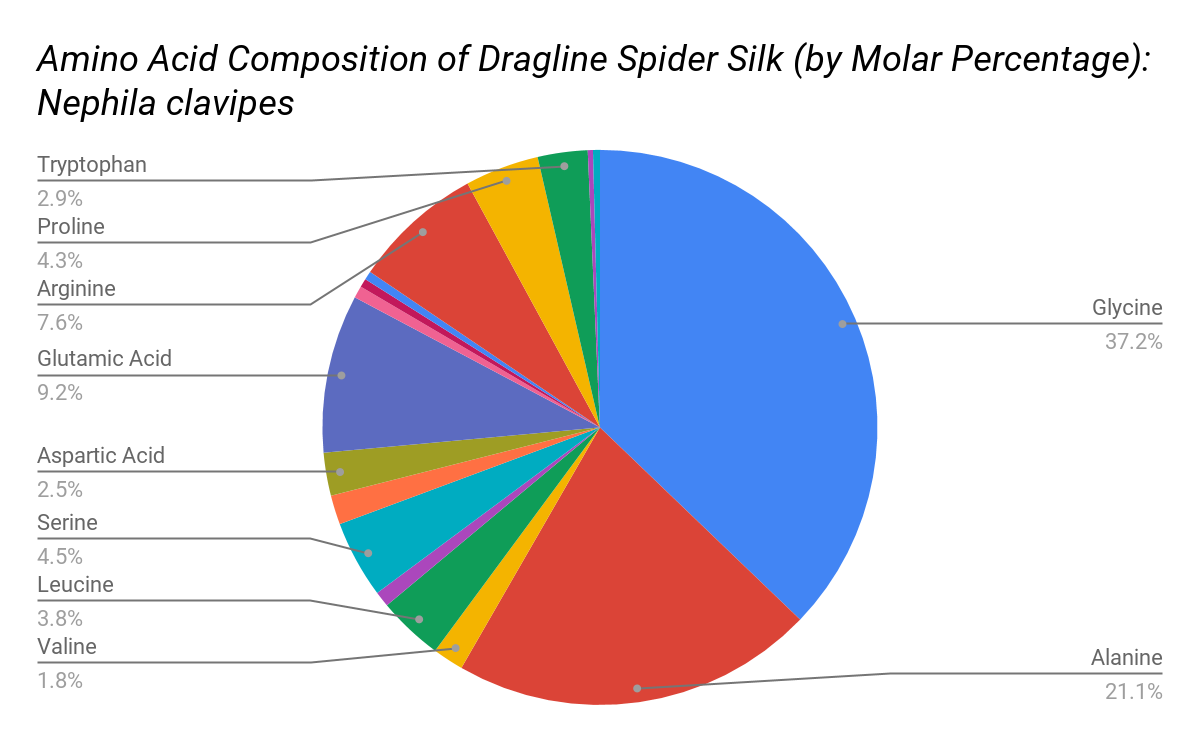
I also created a nifty pie chart that easily visualizes how much of the protein is made from glycine and alanine.

I will definitely be ready for my presentation.


- Noah

Wednesday, January 17, 2018

Thesis Presentation work day 2

Today I primarily worked on the "Potential Applications and Uses" section of my presentation. It's the main focus of my thesis and should serve as an adequate "wow" factor. I won't show the slide so I won't spoil it.

Here's a different slide though:


Noah

Friday, January 12, 2018

Presentation Preparation

Today I worked the entire period on my presentation that will happen in a couple of weeks. I decided to go ahead and work on it. I actually got into it, I didn't realize I had spent an hour and a half preparing this presentation. I'm mostly done, I just need to put in more information and practice presenting it.

This is my first slide:

Hopefully, it'll be a cool presentation.

- Noah

Wednesday, January 10, 2018

First Day Back (After Winter Break)

After two weeks off, it's good to be back in school. I'm excited for E&M and learning more about the mathematics of integrals in calculus.

Today in thesis, I worked on organizing what information I will be presenting and synthesizing from. I focused on my first topic: Structure and Resulting Properties. I found multiple new authoritative resources specific to this topic. Over the next few weeks, I will be progressing through my topics and eventually will craft a paper that will present what I have learned. I can also at that time begin preparing how I will deliver my presentation. I might also like to know what professions the judges will be. Because my topic is so specific, I'm not sure how familiar they might be with it; this will influence how I present my information and research.

Structure and Resulting Properties

Spider silk exists as a chain of proteins, a polymer, with varying and repeating structures that give it both rigidity and elasticity. It exists as 𝛽-sheets that form helices (𝛼-helices in solution). “Amyloid fibrils share similarities with 𝛽-sheets of spider silk and have been observed in the distal third of the spinning duct by electron microscopy (EM), and it was proposed that the spidroin repetitive parts are responsible for the amyloidogenic behavior.” (“Carbonic Anhydrase…” pg 3) Rich in glycine and alanine residues.
𝛽-sheets allow for the mechanical/tensile strength of spider silk
Macroscopic Structure:
Essentially, silk exists as a layered cord with an external crystalline “skin” that covers an internal structure of polypeptides. This skin protects the integrity of the inside while also allowing the silk to be antimicrobial. The inside can best be described as 𝛽-sheets, covalently connected, suspended in an amorphous “gel.”(?)
Outer Layer and Shock/Energy Absorption: “Outer layers of Nephila madagascariensis show a thin peripheral layer [of skin] with elongated cavities...oriented parallel to silk fiber axis. These domains act as stress concentration points, crack initiators that inhibit the spreading of  the cracks by delaying the rupture of the fiber by taking up the energy. The inhibition effect of these domains arise from self repairing of cracks by solidification under high stress areas, plasticizing effect by hydration to act as fluid shock absorbers, and act as a lubricant to reduce the inter[-]fibrillar friction.” (3. Pg 8)
“Under tension, the glycine-rich sequences are able to perform large-scale beta sheet crystal structures that are less perfectly ordered than polyalanine crystals.” (3. Pg 8)
Optical Properties (Birefringence): “The birefringence of Nephila clavipes liquid protein  is low to the extent of .01 to .002 and the contribution of form birefringence to the total birefringence of the fiber has been found to be more significant.” (3. Pg 9)
Thermal Properties:
Y (Thermal expansion coefficient) = -10.6 x 10⁻⁴ ℃⁻¹
“...fibers are thermally stable up to 230℃.” (3. Pg 11)
Electrical Properties:
Spider silk is not piezoelectric.
Fine Structure:
Spider silk has both amorphous (oriented and non-oriented) and crystalline regions.
Primary-
Secondary-
Tertiary-
Quaternary-
References:

Synthesis: The Chemical and Physical Processes

Replication in a Laboratory for Biomimetic Synthesis

Designing and Constructing a Theoretical “Biomimetic Silk Spinner”

Potential Applications and Uses
References:


- Noah

Friday, December 15, 2017

Final Day of the 1st Semester (well, before finals)

Today, you guessed it, I worked on my mid-term thesis report. That pretty much sums it up. Brevity is a nifty thing isn't it?


- Noah

Wednesday, December 13, 2017

Mid-term nearing completion

Today I worked on my mid-term report some more. I'll likely be done ahead of Monday. Really what's left to do is just edits, and some touch-ups here and there.

- Noah

Monday, December 11, 2017

Thesis Days(12/8-12/11)

Today I spent most of my time working on my mid-term report, polishing the conclusion, and reading more reports and publications. It'd be nice if there aren't any mistakes in them.

On a college note, I will hear back soon from SMU, TCU, and MIT. Well, I'll actually know from MIT on Thursday at 5:28 PM.

- Noah

Thursday, December 7, 2017

Today I worked on my mid-term report, correcting errors, updating, and trying to write a decent conclusion.

- Noah

Tuesday, December 5, 2017

thesis day- no more college days

today, I read through the papers I have so far. I'm definitely starting to understand it better. I'm also thinking about how I will organize my final paper and presentation. I think I'll talk about the actual synthesizing process and all the chemistry, etc. then talk about the real-world and potential applications. At the actual presentation, maybe I'll have a prototype biomimetic spinner.

- Noah

Monday, December 4, 2017

Dec. 2-4

I finished and submitted my UT application, and so all that's left is to touch up a couple of supplements for Rice.

As for the messed up math, the equation for stored energy should be the area of the stress-strain graph. The energy should be per unit volume. Neat. I found a mistake in a publication(?).

- Noah

Friday, December 1, 2017

College day (Dec.)

Today I worked on refining my Apply Texas essay, and made edits based on suggestions made. I plan to submit the rest of my applications in the following couple of weeks. I should be completely finished before the end of December.

- Noah

Wednesday, November 29, 2017

College work day

Today I worked on my ApplyTexas essay, and also updated/edited information in the website for my UT application.

(I also looked at audition music for MIT ensemble/jazz band so I'll be ready for auditions next year. Mainly just for any college, not just MIT. The music was for this year, so I'm not counting chicks before they hatch, I just like to be best prepared for any scenario.)

- Noah

There's a mistake in the math...?

Yesterday, I realized that the equation used in the study to find the energy stored in the silk as it is stretched is odd. The units don't work out, so I'll have to find a solution and fix it. (Dr. J confirmed that it had incorrect units.)

- Noah

Monday, November 27, 2017

After the break

To briefly summarize what I did over the break: I worked on my supplements, my Apply TX essay, and read up on my thesis. (I'm still trying to understand the "lock and trigger" mechanism described by SLU.)

Today I'm working on my mid-term report and my Apply TX essay. I'm hoping to submit my UT app by thursday. After that, really the only one left is Rice, which I'm essentially finished with. I just need to make sure the supplementals are solid. 

Oh! Also I found this neat study of spider silk. It describes how qualities were quantified and has a ton of data. I also found equations used in the study that may be helpful.


- Noah

Monday, November 20, 2017

I'm Back

I got back from the campout yesterday. (It was cold and very windy.) I didn't manage to make a post yesterday, and quite honestly, I didn't work on my thesis. I fell asleep.

This post will be my itinerary for the week, so if I forget to log a day, you'll know what I'm up to.

Monday (today): Work on Rice supplemental essays

Tuesday: Read on thesis

Wednesday: Read on thesis

Thursday: I will be eating copious amounts of turkey, potatoes, cranberry sauce, and pies.

Friday: Work on college applications for Dec. 1/Jan. 1 deadlines.

Saturday: Eagle Scout Court of Honor

Sunday: Update/edit mid-term report


- Noah